Why Farrington's Grove Basements Are Different
Farrington's Grove is one of Terre Haute's most beloved historic neighborhoods, and its Victorian and early twentieth century homes are a point of pride for the people who own them. Those homes also come with basements built from local limestone, mortar, and sometimes brick, using construction methods that predate modern concrete and modern waterproofing. When a homeowner here searches for historic home basement waterproofing, the advice they find online is usually written for poured concrete foundations from the 1970s and later. That advice simply does not apply.
Limestone is a porous, sedimentary stone. It absorbs water, it spalls when moisture freezes inside it, and it was laid by masons who expected the foundation to breathe. The mortar joints were softer than the stone on purpose, so that movement would crack the mortar rather than the limestone itself. Over a century of freeze and thaw cycles, those joints erode, the parging on the interior face crumbles, and water finds its way in. Understanding that history is the first step toward solving an old foundation leak without damaging the character of the house.
Common Signs of Limestone Foundation Trouble
Most limestone foundation problems in Farrington's Grove announce themselves long before a basement floods. Homeowners often notice a white, chalky powder on the interior walls, which is efflorescence, the mineral residue left behind when water moves through the stone and evaporates. They notice dark damp patches after heavy rain, a musty smell that never quite goes away, or paint and parging that bubble and peel. On the exterior, look for settled soil against the foundation, downspouts that dump water within a foot of the wall, and mortar joints that have recessed noticeably compared with the surrounding stone.
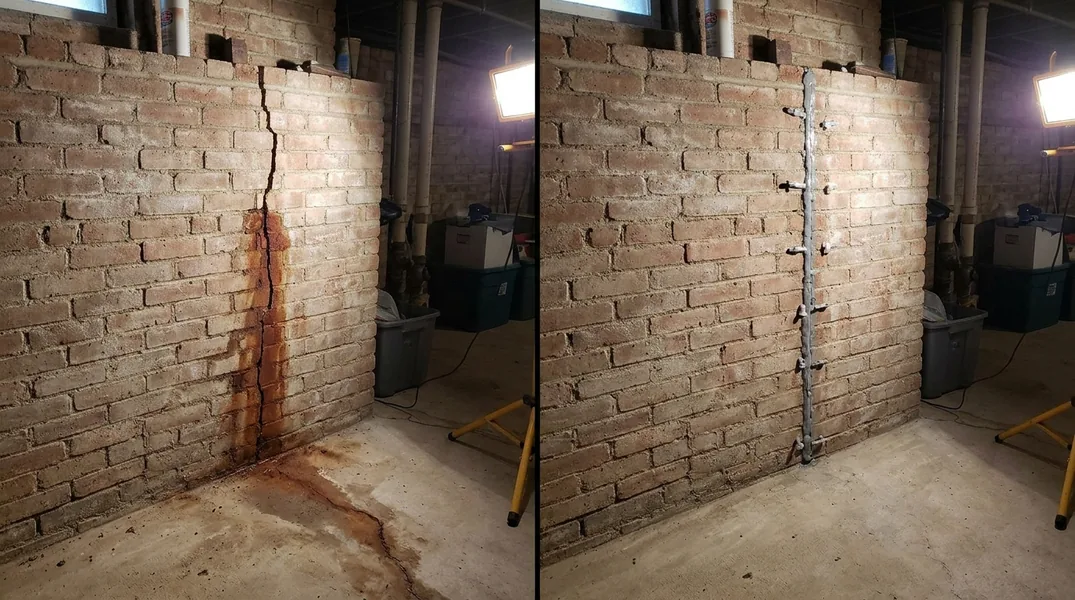
More serious signs deserve prompt attention. Horizontal cracks, bowing walls, or a stair step crack running through the mortar are structural warnings, not just cosmetic ones. In a Victorian home basement, those patterns usually mean water pressure from saturated soil is pushing against a wall that was never designed for modern drainage loads. If you see any of these, it is worth scheduling a free estimate so a professional can tell you whether the issue is moisture control or structural repair.
Repointing Mortar the Right Way
Foundation repointing is the single most important maintenance task for a limestone foundation, and it is also the one most often done incorrectly. The original mortar in these homes is lime based and relatively soft. Modern Portland cement mortar is hard, strong, and completely wrong for old stone. When a hard cement patch is applied over a soft lime joint, the cement refuses to flex, so the next freeze cycle cracks the limestone face instead of the mortar. That is how a small repointing job turns into stone replacement.
Proper repointing means grinding out the deteriorated joint to a consistent depth, cleaning it thoroughly, and packing in a compatible lime based mortar that matches the original in strength and flexibility. It is slow, careful work, and it is the reason Foundation Waterproofing on a historic home looks different from waterproofing on a newer build. Repointing alone will not stop a wet basement, but skipping it guarantees that any other waterproofing work will eventually be undermined by crumbling joints.
Waterproofing Strategies That Respect Old Masonry
The cardinal rule of old masonry is that it must be allowed to dry toward the interior. Sealing the inside face of a limestone wall with a heavy epoxy or cementitious coating traps moisture inside the stone, and the result is spalling, crumbling, and eventually structural damage. Instead, the goal is to manage the water before it reaches the wall and to give any moisture that does enter a path to drain away harmlessly. That is where an Interior Drain Tile System earns its place in a historic home. A perimeter drain at the base of the footing, paired with a sump pump, collects water that comes through or under the wall and moves it out without altering the exterior appearance of the house.
On the outside, Exterior Basement Waterproofing can be effective, but it must be done with care in a historic district. Excavation near mature trees and original landscaping is disruptive, and any coating applied to the exterior face needs to be vapor permeable. In many Farrington's Grove cases, the smartest approach combines exterior grading and drainage corrections with interior water management, so the foundation is protected from both sides without sealing the stone. A full Basement Waterproofing plan for a historic home is always tailored to the specific wall construction, not pulled from a standard package.
Historic Home Basement Waterproofing Near Me: When to Call a Pro
Some tasks are reasonable weekend projects: extending downspouts, regrading soil so it slopes away from the house, and clearing gutters. Others are not. If your basement has standing water after storms, if the mortar joints are visibly recessed, if you see efflorescence spreading across the walls, or if any wall is bowing, it is time to bring in someone who works on limestone foundations regularly. Attempting a DIY fix with hydraulic cement or a box store sealer often makes the problem worse and more expensive to correct later.
When you call Terre Haute Waterproofing at (930) 666-4110, the conversation starts with the house, not a product. We look at the stone, the mortar, the grading, and the drainage, then explain what is actually happening and what options make sense for a home of that age. Homeowners in West Terre Haute and Seelyville with older foundations get the same assessment. If you want a straightforward answer about your basement and a pricing range before any work begins, reach out and we will set up a visit.
Keeping Your Historic Basement Dry for the Long Haul
Once the immediate leaks are addressed, maintenance is what protects the investment. Check the mortar joints every couple of years and touch up small areas of deterioration before they grow. Keep gutters clean and make sure every downspout discharges at least four to six feet from the foundation. Watch the soil line around the house, since settling backfill is common on older properties and creates a bowl that holds water against the wall. Inside, keep storage off the floor and maintain airflow so humidity does not build up in the summer.
Historic homes in Farrington's Grove are worth the extra care. A dry limestone basement is not an impossible goal, but it requires methods designed for the material. If you are unsure where your basement stands, a professional inspection is the fastest way to find out. Call Terre Haute Waterproofing at (930) 666-4110 or request a free estimate, and we will help you protect both your home and its history.
Looking for a professional basement waterproofing contractor in Terre Haute? Terre Haute Waterproofing responds fast for all your basement waterproofing needs.
Get a Free QuoteOur services: Basement Waterproofing · Interior Drain Tile System · Exterior Basement Waterproofing